Saturday, November 29, 2008

Robert Kiyosaki and Suze Orman on Money

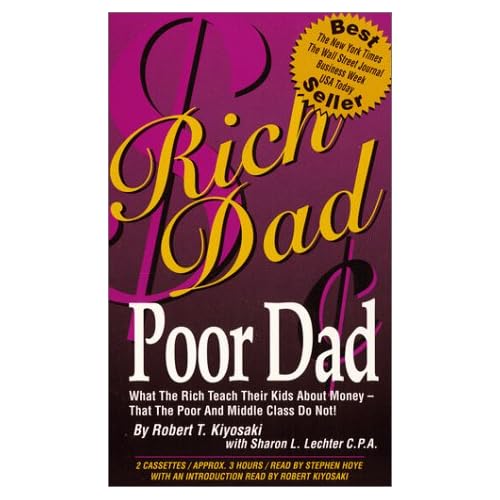
Robert Kiyosaki is coming to Singapore to speak. I wonder how many people in the past years has been under the influence of best selling author Robert Kiyosaki, the author of Rich Dad Poor Dad rather than Suze Orman. Judging from the current credit crisis in America, I'd say many has fallen under the spell of Kiyosaki instead of following the conservative advise of Suze Orman. I have not personally read the Kiyosaki book. All I know about Kiyosaki I heard second hand from my husband who listened to his audio book. The following are just some of the flawed principles I recalled to have heard that is directly relate to the credit and mortgage crisis happening in America:
  • When buying a home on the upward market, max out on the credit the bank is willing to give because the bigger the investment, the bigger the gain.
  • Money can make you more money when invested properly. Employ money to work for you. In another word, do not use your cash for purchases. Buy on credit if you can and invest your hard earned cash instead. Return on cash investment can be higher than the interest you incurred.
Robert Kiyosaki's book maybe more comprehensive in laying out all the principles, the pit falls, and the danger. Many people, however, either did not read the whole book or selectively remembered only what they liked to hear.

I watched the Suze Orman's show several times. She, on the other hand, always advocates the following:
  • Use money to take care of your people first, safe a portion for retirement, and spend what's left.
  • Get a mortgage size that suit your income (mortgage payment should not be more that 30% of your income after taxes, if I remember correctly).
  • Buy on credit only for your residential home and college education. The rest buy only if you have the money. But make sure you take care of your people and save a portion for retirement. She often says, people first, then money, then things.
I don't claim to be a financial expert but I am not comfortable with Kiyosaki's reckless abandon way in investing. I also believe, Orman's conservative principles may not suit others. But so far, her advice has help me secure our family's financial future while still allowing me to sleep well at night.

Tuesday, November 25, 2008

Cherie Blair to Michelle Obama


In Strait Times, 28 November 2008, it is reported that Mrs Blair gave Mrs Obama an unsolicited advice. This is what was reported she said,

"My advice for Michelle Obama: Learn to like the back seat.... Brace yourself for a big letdowns in your life as First Lady.... You have to learn to like the back seat, not just in public, but in private. When your spouse is late to put the kids to bed, or for dinner, or your plans for the weekend are turned upside down again, you simply have to accept that he had something more important to do.... It is something of an irony that in these days of pushing for equality those of us married to our political leaders have to put their own ambitions on hold while their spouses are in office and keep their view to themselves."
It strike me that the same advise can be bestowed upon the wives of church leaders and church pastors. Sad to say, the church organization can sometimes be very political with different political parties playing the field. A wife who doesn't subscribe to the husband's political allegiance can cause embarrassment to the husband. Is it a wonder why many wives of "majelis" choose to be uninvolved and keep themselves invisible?

Monday, November 24, 2008

Advance Medical Directive

There has been discussion on the Strait Times on the issue of Advance Medical Directive (AMD), Euthanasia, and assisted suicide. In the recent years, taking care of our parents has been an issue faced by a number of our friends. One friend's mother is at the final stages of cancer which originated in the gum, he moved her to his house and his wife took care of her every need. Another friend's mother is in coma after a massive stroke. She is on life support in a nursing home. Living in a different state, he and his siblings took turn to visit. Another friend's father is suffering from a severe case of emphysema, and has been going in and out of hospital for the past 12 months. Lucky for him, he has 6 sisters, they all chip in to help with the care. Another friend's father is having lung cancer that's spreading to the brain and he is asking his wife to quit her job to take care of him. Another friend's father is on dialysis and need help with breathing, the father has substantial saving so he is in an elite nursing home with 24 hours private nurse caring for him. Two friends' parents are suffering from colorectal cancer. The list can go on and on, it's depressing sometime. There is no question, we should be prepared for this. It is an unpleasant interruption to one's life. The financial and emotional toll is high on the family.

While assisted suicide and euthanasia is wrong, how about AMD? Certainly, I don't want to be a burden to my children, but who are we to be the decision maker in what is to be part of life's lesson. Adversities and difficulties is God's way perfecting us, euthanasia and AMD may get in the way of God's plan.

This blog by Lorri Curto tells a story how God works in mysterious ways.

Saturday, November 15, 2008

Confusion on the Zebra Crossing

In Singapore, neither the driver nor the pedestrians seem to know what to do at the zebra crossing. There seem to be a disagreement between motorists and pedestrians. There are several types of pedestrian.

The first type is young people between JC/Poly age. They are usually confident of their right of way. They are so confident that sometimes they don't bother to stop, look and listen, and just make an abrupt turn to cross and often never look up from their hand phone. For these, drivers really must be on the look out. Cars would stop, sometime at the nick of time with the driver cursing the pedestrian

The second type usually is an elderly, an obese person, a primary school child, or anybody who can't walk very fast. They usually will stand at the mouth of the zebra crossing, and waited for the car to stop from both direction, or waited until they don't see any car from both direction. These people do not have confidence that the cars will stop for them.

It is for these pedestrian that drivers often do not stop and here is why. Let say you are a driver, and from far away you saw a pedestrian at the mouth of a crossing. In the driver's opinion, the pedestrian could have made a save crossing even before the car reached the crossing. But this pedestrian is the type who only cross when cars from both direction already stopped or no cars can be seen. The driver in turn thought that maybe he/she did not intent to cross at all, so the driver did not stop the car. The pedestrian then thought, "Feuh ... good thing I did not risk my neck, see this driver did not stop."

Where my children are concern, I told them to never assume that cars will stop. But I also to instruct them to give a clear signal that they need to cross by raising one hand and look at the driver in the eye.

Monday, November 10, 2008

Breach of confidentiality

Should Pastors and other church workers be called to account for breach of confidentiality they committed? To date, I have not heard of any Indonesian church who asked its pastors and bible teachers to sign a confidentiality agreement. Meaning that any information that they hear from counseling session with church members, formal or informal, will not be divulged to anybody without the other's consent. I believe it is time that the Indonesian churches have some sort of guidelines for its pastors and workers. It is unethical to tell others personal problems that they hear from church members. It is even worse when a pastor uses it as an illustration in his or her sermon without permission.
In a sermon I heard, a young couple who were about to be married were mentioned. Although the said couple and I lived in different countries, and we did not know one another, enough details were given that I could somehow connect the dots and pin-point which couple the pastor was referring to with some degree of precision. The illustration, unfortunately, painted a rather unfavorable picture of the couple as spoiled young adults from rich families who don't know how to count their blessings and are whining over something that others would have rejoiced over.

Why did the pastor do that? Was it unintentional? Was he clueless about how inappropriate he was? Or was he smarting over not being asked to officiate the wedding?

At any case, guidelines should be established. It does occur to me that maybe others don't share the same opinion on the issue. Maybe, I have lived too long in a western world and my mindset is just too westernized. Maybe, it's because confidentiality is a big issue in the helping profession I am in so my level of expectation is skewed. What do you think?